Travel
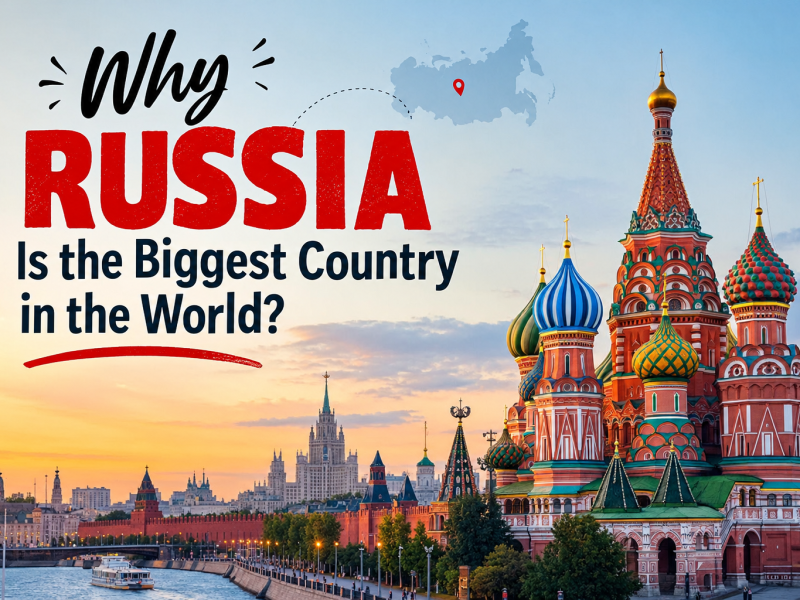
Why Russia Is the Biggest Country in the World?
October 10, 2026
October 10, 2026
Russia is known for its rich history, famous cities, cold winters and remarkable landscapes. However, one fact makes it stand out on the world map: Russia is the biggest country in the world by total area. Covering approximately 17.1 million square kilometres, it stretches across Eastern Europe and Northern Asia, occupying a huge part of the Eurasian continent.
But why is Russia so large? How does its geography compare with other countries, and what makes its enormous territory so interesting? Understanding these questions reveals how geography, history and natural landscapes have shaped the world's largest nation.
Russia covers approximately 17,098,242 square kilometres, including land and inland water. Its total area is around 1.8 times the size of the United States, making it larger than any other country.
Canada, China and the United States are also among the world's largest countries, but none exceeds Russia in total geographical area.
Russia's enormous size becomes easier to understand when you look at its position on a world map. The country extends from the Baltic Sea region in the west to the Pacific Ocean in the east. Its northern territories reach the Arctic Ocean, while its southern regions extend towards the Caucasus and Central Asia.
This vast geographical spread gives Russia a wide range of landscapes, natural resources and climatic conditions. It also explains why travelling across the country can involve long journeys and significant differences in local time and weather.
One major reason Russia occupies such a large area is its location across Europe and Asia.
The western part of Russia lies in Eastern Europe, while much of its territory extends across Northern Asia. The Ural Mountains traditionally mark the geographical boundary between these two continents.
As Russian territory expanded eastwards over several centuries, it incorporated enormous areas of forests, plains, river valleys and sparsely populated land.
Unlike countries confined to a single small region, Russia extends across thousands of kilometres of continental territory. Its position gives it a distinctive place in world geography and connects its landscape to several different climatic and environmental regions.
This east-west spread is one of the clearest reasons Russia remains the largest country in the world.
Russia's landscape is not made up entirely of mountains or rugged terrain. Large plains cover significant parts of the country, including the East European Plain and the West Siberian Plain.
These extensive areas contribute to Russia's enormous geographical footprint. The country also contains the Siberian taiga, a vast belt of coniferous forests that stretches across northern Asia.
Further south, grasslands known as steppes cover broad areas. Mountain ranges, including the Caucasus and Altai Mountains, add further geographical variety.
The Lena, Ob, Yenisei and Volga are among Russia's important rivers. These waterways have influenced settlement, transport, agriculture and economic activity throughout the country's history.
The combination of plains, forests, mountains, rivers and Arctic landscapes makes Russia geographically diverse despite its reputation for extreme cold.
Russia did not acquire its present geographical extent overnight. Its territory expanded over several centuries through exploration, settlement, political expansion and the incorporation of neighbouring regions.
From its European heartland, Russian expansion moved eastwards across Siberia towards the Pacific coast. This process brought increasingly large areas of Northern Asia under Russian control.
The development of settlements, trade routes and administrative centres helped connect distant territories. However, the enormous distances between regions also created practical challenges for transport, communication and governance.
Russia's modern geographical size reflects this long historical process rather than a single geographical event.
Its history helps explain how a country centred initially in parts of Eastern Europe came to occupy such a substantial portion of Northern Asia.
Another remarkable feature of Russia's size is its spread across eleven time zones.
When it is morning in western Russia, the easternmost regions can already be well into the afternoon. This difference reflects the country's enormous east-west distance.
Managing business, transport, public services and communication across these time zones requires careful coordination.
The time difference also affects travellers. Someone visiting Moscow and then travelling to Vladivostok will experience a considerable change in local time, alongside a journey spanning thousands of kilometres.
Russia's multiple time zones are therefore more than an interesting geographical fact. They demonstrate how its size influences everyday life, travel planning and communication across the country.
Russia is often associated with freezing temperatures, but its climate is not the same everywhere.
Northern areas experience Arctic conditions, while much of Siberia has a subarctic climate with long, cold winters. Parts of European Russia experience continental weather, with warmer summers and cold winters.
Southern regions include steppe landscapes, and areas near the Black Sea have comparatively milder conditions.
These differences are closely linked to Russia's size, latitude and distance from the oceans. Many inland areas experience more extreme seasonal temperatures because the sea provides less moderating influence.
The climate affects agriculture, housing, transport and the daily routines of local communities. It also means visitors must consider their destination and travel dates carefully instead of assuming that every part of Russia experiences identical weather.
Although Russia is the largest country in the world, its population is spread unevenly across its territory.
A large share of the population lives in the western part of the country, particularly around major urban centres such as Moscow and Saint Petersburg.
Eastern regions contain enormous forests, remote settlements and extensive areas with relatively low population density. Harsh winters, long distances and limited transport connections make some areas more challenging to inhabit.
This uneven distribution explains why Russia's geographical size should not be confused with population size.
The country has extensive natural landscapes, but its major cities remain important centres of employment, education, culture and transport.
Russia's vast territory contains a wide variety of natural environments, from Arctic tundra and dense forests to mountain landscapes and grasslands.
Lake Baikal, located in southern Siberia, is famous for its exceptional depth and freshwater ecosystem. The Kamchatka Peninsula is known for its volcanoes, geothermal features and dramatic scenery.
The Altai Mountains offer striking mountain landscapes, while the forests of Siberia support diverse wildlife and important ecological systems.
These natural features make Russia interesting to geographers, researchers, photographers and travellers.
However, exploring such places requires realistic planning. Distances between attractions can be substantial, and weather, transport availability and seasonal access can affect an itinerary.
Russia's geography creates opportunities for very different travel experiences. Moscow offers famous landmarks, historic architecture and cultural attractions. Saint Petersburg is known for its canals, grand buildings and celebrated museums.
Travellers interested in natural scenery may be drawn to Lake Baikal, the Altai region or the volcanic landscapes of Kamchatka.
The important point is that Russia cannot be explored as though every destination were close to the next. A trip focused on major cities will require a different plan from one centred on remote natural areas.
Anyone considering international travel should research entry requirements, current transport options, seasonal conditions and local travel advisories before making arrangements.
For travellers comparing destinations and planning holidays, Vcationswale can help with exploring international holiday options and organising suitable travel plans. Reviewing destinations, travel dates and available packages in advance makes it easier to build an itinerary around individual interests and practical requirements.
Russia is the largest country by total area because its territory extends across Eastern Europe and Northern Asia, covering approximately 17.1 million square kilometres.
Canada is generally ranked second by total area, although rankings can vary slightly depending on how land and water areas are measured.
Russia spans eleven time zones, reflecting its enormous east-west geographical extent.
No. Although many northern and Siberian regions experience severe winters, southern areas and parts near the Black Sea have different climatic conditions.
It depends on the destinations, available time and transport arrangements. Because distances are enormous, most travellers benefit from focusing on selected cities or regions rather than attempting to cover the entire country.
Russia is the biggest country in the world because its territory spans an extraordinary stretch of Eastern Europe and Northern Asia. Its extensive plains, forests, mountain ranges, historical expansion and eleven time zones all help explain its remarkable geographical scale.
Its size also creates challenges, including uneven population distribution, long travel distances and sharply different climates. At the same time, it offers a remarkable range of cultural landmarks and natural environments.
For anyone interested in geography or international travel, Russia provides a clear example of how a country's physical size can influence its history, environment and everyday life. With thoughtful research and suitable planning, travellers can explore destinations that match their interests while making the most of their time abroad.