Religious Tourism
10 Interesting Facts About Kedarnath Temple You Should Know
August 28, 2026
August 28, 2026
High in the Garhwal Himalayas, surrounded by towering peaks and the quiet flow of the Mandakini River, stands Kedarnath Temple. For devotees, it is one of the holiest places dedicated to Lord Shiva. For travellers, it is also one of India's most remarkable mountain destinations.
But there is much more to Kedarnath than its famous temple and challenging trek. Its history, architecture, legends, location and connection with the wider Char Dham pilgrimage make it a place worth understanding before you visit.
Here are 10 interesting facts about Kedarnath Temple that reveal why this Himalayan shrine holds such a special place in India's spiritual and cultural landscape.
Perhaps the most important fact about Kedarnath is its status as one of the twelve Jyotirlingas dedicated to Lord Shiva.
The temple is also an important part of the Panch Kedar pilgrimage circuit. According to popular Hindu tradition, the unusual conical form of the Shiva shrine at Kedarnath represents the hump of Lord Shiva. The remaining parts associated with this legend are worshipped at Tungnath, Rudranath, Madhmaheshwar and Kalpeshwar.
This religious significance is one of the main reasons pilgrims travel to Kedarnath despite the demanding journey.
Kedarnath has a history that goes back centuries. The present temple structure is generally believed to be more than 1,200 years old, while traditional accounts connect the original shrine with the Pandavas.
According to the popular legend, the Pandavas came to the region seeking Lord Shiva's blessings after the Mahabharata war. The story says that Shiva appeared in the form of a bull and eventually disappeared into the ground, leaving his hump at Kedarnath.
The Uttarakhand Tourism Department also attributes the establishment of the present temple to Adi Shankaracharya around the 8th century.
It is worth remembering that these accounts belong to religious tradition and legend rather than modern archaeological history.
Kedarnath is not an ordinary low-altitude pilgrimage destination. The temple sits at approximately 3,580 metres above sea level in the Garhwal Himalayas.
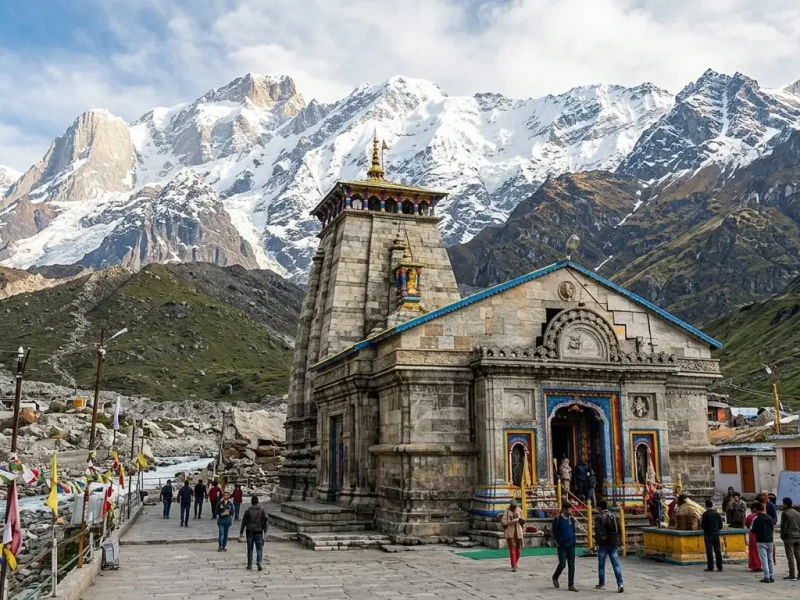
The high-altitude setting is part of what makes the journey so distinctive. Kedarnath Peak, Kedar Dome and other Himalayan mountains form the dramatic backdrop around the temple.
The elevation also means travellers need to take the weather and physical demands of the journey seriously, particularly if they are not accustomed to high-altitude travel.
Look closely at Kedarnath Temple and one of the first things you notice is its construction.
The temple is built using large, evenly shaped grey stone slabs. Uttarakhand Tourism describes the shrine as being constructed from extremely large stone blocks, while the temple itself stands on a rectangular platform. Inside, devotees worship the distinctive conical form associated with Lord Shiva.
The simplicity and strength of the stone structure are particularly striking when you consider the remote Himalayan location in which it was built.
The devastating Uttarakhand floods of 2013 changed the landscape around Kedarnath and caused widespread destruction.
Yet the main temple structure survived.
Behind the temple is a large boulder known as Bheem Shila. According to local belief, the rock came down during the disaster and helped divert the flow of water and debris away from the main shrine. Uttarakhand Tourism records this account while describing the temple's survival during the floods.
For many devotees, Bheem Shila has since become a powerful symbol of protection and faith.
Kedarnath is closely connected with the surrounding Himalayan landscape.
The temple town lies near the Chorabari Glacier, from which the Mandakini River originates. The river and surrounding peaks give the area its distinctive character, combining religious importance with a dramatic natural setting.
Travellers can also explore places such as Gandhi Sarovar, also known as Chorabari Lake, although weather conditions can change quickly in this high-altitude region.
One of the most practical facts every first-time visitor should know is that you cannot simply drive all the way to the temple.
The road journey ends at Gaurikund, from where pilgrims continue towards Kedarnath on foot or use available alternatives such as ponies and palanquins. Official Uttarakhand Tourism information gives the trek distance at roughly 14–16 km depending on the route/reference used, while other official pilgrimage material lists longer route measurements.
That makes preparation important. Comfortable footwear, suitable warm clothing, adequate water and a realistic travel schedule can make a considerable difference.
Kedarnath is one of the four major pilgrimage destinations in Uttarakhand's Char Dham Yatra, alongside Yamunotri, Gangotri and Badrinath.
The traditional pilgrimage route proceeds through these four Himalayan shrines, each associated with a different deity and sacred tradition. Kedarnath is dedicated to Lord Shiva, while Badrinath is associated with Lord Vishnu.
Because of this connection, many travellers plan Kedarnath as part of a wider Char Dham or Do Dham pilgrimage rather than visiting it alone.
The harsh Himalayan winter makes it difficult to keep the high-altitude shrine accessible throughout the year.
During winter, the symbolic representation of Lord Kedarnath is brought down to Omkareshwar Temple in Ukhimath, where worship continues until the Kedarnath shrine reopens for the pilgrimage season. Uttarakhand Tourism identifies Omkareshwar Temple in Ukhimath as the winter seat of Lord Kedarnath.
This tradition allows devotees to continue the worship even when heavy snowfall makes the upper Himalayan route inaccessible.
Kedarnath is spiritually significant, but it is also a high-altitude journey. Weather, trekking conditions, accommodation, transport and pilgrimage registration all need attention before leaving home.
For the 2026 Yatra, the official Uttarakhand pilgrimage portal lists Kedarnath's opening date as 22 April 2026 and provides online registration facilities. The official portal also states that pilgrims should complete registration and carry their registration documentation during the journey.
The best months can vary depending on weather and official arrangements. Summer generally offers favourable conditions, while the monsoon can make travel more difficult because of rain and landslide risks. The official Badarinath-Kedarnath Temple Committee also advises travellers to be cautious during the monsoon period.
If you are thinking about visiting Kedarnath, arranging the journey in advance can make the experience considerably easier. Transport, accommodation, route planning and other travel arrangements can become complicated during the busy pilgrimage season.
VcationsWale can help travellers plan their Kedarnath and Uttarakhand pilgrimage with suitable travel packages and organised arrangements. Whether you are planning a Kedarnath trip with family, friends or a larger group, having the major parts of the journey planned beforehand lets you spend less time worrying about logistics and more time experiencing the destination.
For travellers considering a wider pilgrimage, a Kedarnath–Badrinath Do Dham Yatra or a complete Char Dham Yatra can also be planned according to the available travel days and preferred mode of transportation.
Kedarnath Temple is famous for its religious importance as one of the twelve Jyotirlingas of Lord Shiva and as one of the four major shrines of Uttarakhand's Char Dham pilgrimage. Its remote Himalayan location and ancient stone architecture add to its appeal.
Kedarnath Temple is situated at approximately 3,580 metres above sea level in Uttarakhand's Garhwal Himalayas.
Gaurikund is the roadhead for the Kedarnath journey. The trekking distance is generally described as around 14–16 km, although official sources use different measurements depending on the route and itinerary.
Yes. Kedarnath is one of the four pilgrimage sites of Uttarakhand's Char Dham Yatra, along with Yamunotri, Gangotri and Badrinath.
The opening date changes each year according to the traditional calendar and official announcements. For 2026, the official Uttarakhand pilgrimage portal lists 22 April 2026 as the Kedarnath Dham opening date.
The journey can be physically demanding because of the altitude and mountain terrain. Travellers must reach Gaurikund by road and then continue towards the temple by trek or other permitted modes of transport. Good preparation is especially important for senior citizens and people who are not accustomed to high-altitude travel.
Kedarnath Temple is much more than an ancient shrine surrounded by mountains. Its centuries-old traditions, connection with Lord Shiva, distinctive stone architecture, relationship with the Panch Kedar and Char Dham circuits, and survival during the devastating 2013 floods have all contributed to its extraordinary place in India's spiritual heritage.
For anyone planning a visit, understanding these details before travelling can make the experience more meaningful. And because Kedarnath is a high-altitude pilgrimage rather than a conventional holiday destination, thoughtful planning matters.
If Kedarnath is on your travel list this year, start with the official pilgrimage registration requirements and then plan your transportation, accommodation and itinerary well in advance. For organised travel assistance, Vcationswale can help you put together a Kedarnath or wider Uttarakhand pilgrimage according to your travel requirements.